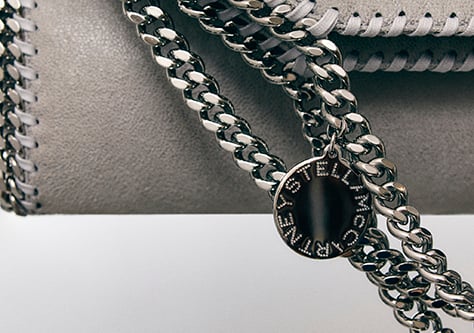


We believe that the future of fashion is circular – it will be restorative and regenerative by design and the clothes we love never end up as waste.
As we continue to push boundaries and challenge the status quo we want to evolve from just reducing our impact to making a positive impact. We want to completely reimagine the fashion industry as we know it and move to a new circular economy.

Altering this linear system demands radical transformation. It involves everyone in the fashion industry working together with unprecedented levels of commitment and innovation. We see this as an exciting opportunity to unleash our collective creative potential, and it is one we are proud to be part of.
- A circular economy looks beyond the current take-make-dispose extractive business model and aims to redefine growth, focusing on positive society-wide benefits.
- It is based on three principles: 1) design out waste and pollution; 2) keep products and materials in use; and 3) regenerate natural systems.
- A circular economy requires that we move away from the consumption of finite (non-renewable) resources, and that we design waste out of the system.
- A new textiles economy (i.e. the circular economy) presents a $500 billion opportunity to the fashion industry.1
- There is a staggering amount of textile waste being produced – the equivalent of 1 garbage truck of textiles gets landfilled or burned every second.2
- Less than 1% of clothing is recycled into new clothes.3
- The clothing waste accumulated between today and 2025 will weigh as much as today’s world population.4
Circular initiatives and partnerships
The transition to a circular economy will require exceptional levels of collaboration across the value chain and the implementation of new sustainable business models. Below are some of our latest initiatives and partnerships that are helping us turn our circular vision into reality.
- We co-hosted the launch of The Ellen MacArthur Foundation’s report, A New Textiles Economy: Redesigning Fashion’s Future. This report outlines an ambitious vision and optimistic future for the fashion industry – a system that ensures clothes, fabric, and fibres are kept at their highest value during use and re-enter the economy after use, never ending up as waste.
- We believe in this vision and will continue to support sustainable and restorative solutions throughout our business.
Every free single industry sharing this Earth needs to look at itself and be responsible, mindful and at the same time still have a healthy business at the end of the day. What is really exciting about The New Textiles Economy Report is that it’s providing solutions to an industry that is incredibly harmful to the environment, these are problems that people are not even aware of.
Our Cradle to Cradle Gold-Level certified wool knitwear yarn has been certified as a safe building block for the circular economy. Find out more about our wool >
- The RealReal gives new life to luxury goods through consignment by providing the largest selection of pre-owned high-end items. This partnership is our first step to making sure our products do not ever end up as waste. By designing pieces that are built to last and embracing The RealReal’s new business model, we are transforming the way our clothes are produced, sold, shared and reused.
- When people buy a product from us, we believe it should be cherished for years. Inspired by this ethos, we co-launched the Clevercare initiative in 2014 to offer a reminder to people to take time caring for their garments and make them last longer. Washing clothes less often and wearing them more can actively help reduce your carbon footprint. Clevercare is a care symbol, a website and a communication campaign all rolled into one.
In July 2019, we collaborated with innovative company Evrnu on the adidas by Stella McCartney collection. Together, we created the Infinite Hoodie – a product made entirely from regenerated, discarded textiles and is itself infinitely recyclable.
Renewable materials
We believe that a modern business is one that benefits the economy, society and the environment. We strive to make this happen by using innovative materials, promoting restorative farming practices and designing products that are made to last.
When considering materials through the lens of the circular economy, they are broken into two categories: technical and biological materials.
Technical materials
Technical materials are materials coming from non-renewable resources. They are inorganic or synthetic materials manufactured by humans such as nylon, polyester, plastics and metals. When optimally recycled, they can be used many times over without any loss in quality – staying in a continuous cycle.
Biological materials
Biological materials come from renewable sources. They are natural fibres that, when manufactured for the circular economy and under the right conditions, can safely decompose into the natural environment (soil, water, etc.) without affecting it in a negative way – providing food for bacteria and microbiological life.
Here are some of the ways that we are embracing circularity in our materials and collections:
- Nylon is a technical material, meaning it is a synthetic material that should be perpetually recycled at the end of use.
- ECONYL® use an innovative technology to turn nylon waste into first-grade nylon yarn, that offers the same quality as virgin nylon. It can then be recycled infinitely, making it a truly circular material. Our collection of Falabella GO bags are created with ECONYL® yarn as well as our Stellawear garments.
- For biological materials, such as cotton, cellulose and wool, to meet the standards of the circular economy, they not only need to be produced in a way that they can safely become soil nutrients (i.e. green chemistry), but they also need to be farmed in a sustainable and regenerative way.
- Transitioning to the use of regenerative methods in agriculture is key, and examples of this include organic farming, restorative grazing and sustainable forestry.
- A regenerative agricultural system preserves the integrity of a farm’s natural ecosystem, increasing its health, biodiversity and resilience. In particular, no toxic substances are used, nutrient losses are minimised, and soil health is not only preserved but enhanced.5
- We source our viscose in a way that protects and enriches ancient forests and the species that live in them. We are the only brand that can trace viscose right back to the tree it came from. As it is one of our key materials, we are committed to making sure that the ecosystems we source from are conserved.
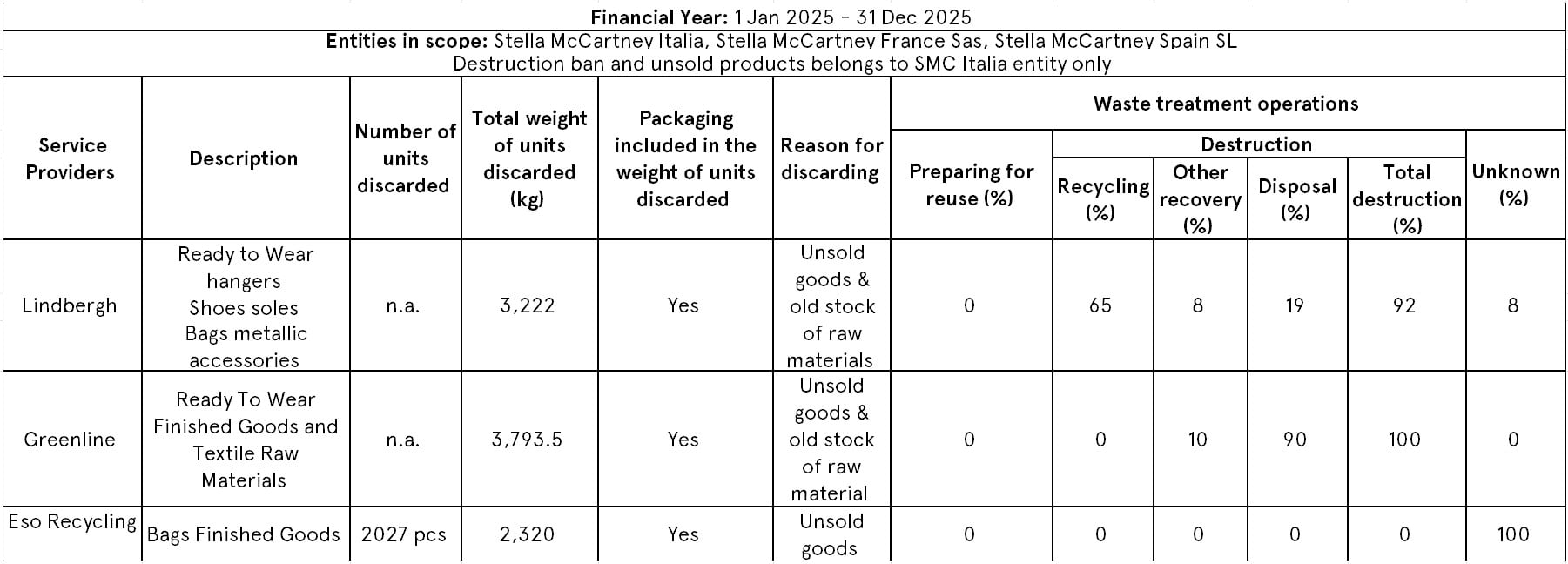
DISCLOSURE OF INFORMATION ON DISCARDED UNSOLD CONSUMER PRODUCTS – Pursuant to Regulation (EU) 2024/1781 (ESPR) article 24
The Ecodesign for Sustainable Product Regulation published in 2024 requires large and medium companies to publish about their data and actions on unsold products to avoid destruction. Circularity has always been part of the Stella McCartney DNA , but action has been taken to further improve operational efficiency and reducing surplus inventory generated through its omnichannel sales activities. These efforts have contributed to a significant reduction in stock levels and unsold products across the business.
Starting from 2024, the company reinforced secondary channels sales through jobbers and Friends & Family events. In this context, the company is also opening new outlets in Europe and North America to support the responsible management of unsold inventory.
At the same time, Stella McCartney has taken further steps to improve sell-through performance across all sales channels and promote the minimisation of seasonal leftovers. These initiatives support more accurate demand planning, stronger inventory management and closer alignment across the value chain, with the aim of maximising sell-through rates and reducing excess stock wherever possible.
Further initiatives aimed at reducing excess inventory in directly managed stores have been implemented since mid-2025. These include seasonal buying optimisation and the reduction of bulk orders produced in advance for potential replenishment purposes. In parallel, the Supply Chain team has been working closely with suppliers to significantly shorten lead times for key products, enabling a more demand-driven approach to production and reducing the risk of surplus stock. Collectively, these initiatives have already contributed to a substantial reduction in inventory remaining in Company warehouses, and the process is ongoing.
As a result, the need for product destruction has also decreased, which is consistent with Stella McCartney’s long-standing objective of avoiding the disposal of unsold products wherever possible.
A further initiative supporting this objective was Stella McCartney’s participation in CircularItalie, which began in 2024. CircularItalie is an Italian recycling and upcycling platform designed to identify alternatives to the disposal or incineration of unsold goods and raw material scraps, in line with circular economy principles and through a network of specialised partners. The platform was established by LVMH, and Stella McCartney joined the initiative in 2024 as one of the first brands within the Group to participate. Although Stella McCartney left the Group in early 2024, it has remained part of the initiative and continues to use the platform as a destination for unsold defective products and raw material scraps when other recovery or sales channels are no longer viable, particularly in the case of defective products and materials.
Data shown in the table below includes products and materials handed over to platform partners in 2025, and refer to Stella McCartney Italia Srl. No activity on unsold products is carried out by other entities of the brand in Europe.